Thailand IFRS S1 S2 Roadmap 2026–2030: What SET50 Must Prepare | ESG PRO
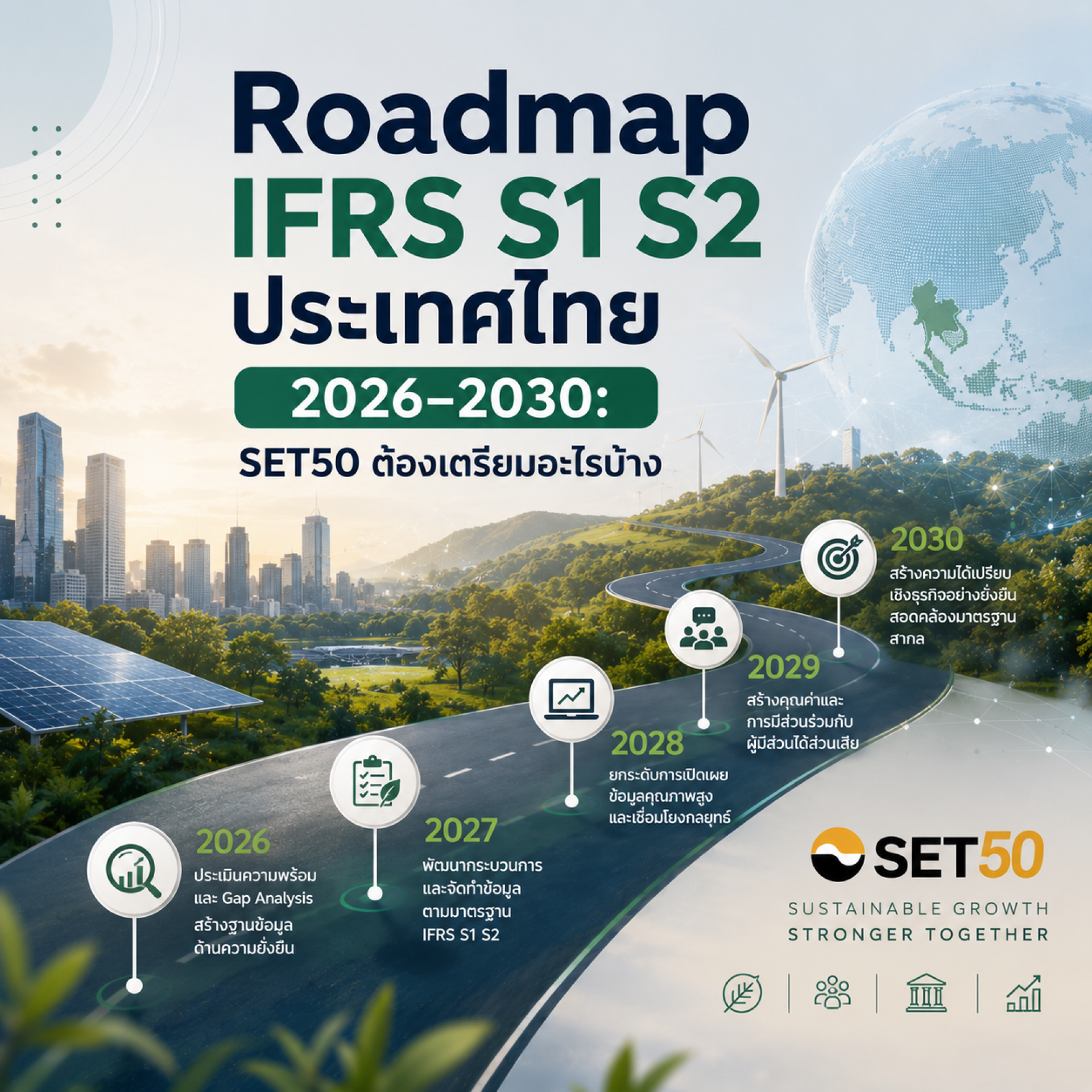
The Securities and Exchange Commission of Thailand (SEC) has initiated the Thailand Sustainability Disclosure Roadmap to systematically adopt IFRS S1 and IFRS S2 (issued by the ISSB) for Thai listed companies. Beginning in 2026, SET50 companies will be the first to disclose sustainability information under this framework.
| Key takeaway: Thailand adopts a climate-first approach with a 4-phase rollout (2026–2030). Companies may begin with climate-related disclosure (IFRS S2 + relevant portions of IFRS S1) and use transition reliefs for up to 5 years before upgrading to full ISSB compliance. |
What Are IFRS S1 and IFRS S2
IFRS S1 General Requirements
Sets overarching requirements for identifying, measuring, and disclosing sustainability-related risks and opportunities that affect cash flows, access to finance, and cost of capital. It is the foundational layer covering all sustainability topics, not just climate.
IFRS S2 Climate-Related Disclosures
A topic-specific standard requiring disclosure of climate-related risks and opportunities across four pillars: Governance, Strategy, Risk Management, and Metrics & Targets.
Thailand's 4-Phase Roadmap (2026–2030)
| Phase | Start Year | Target Group | What Must Be Done |
| Phase 1 | 2026 | SET50 companies | Mandatory climate-first disclosure (IFRS S2 + relevant parts of IFRS S1) in the 56-1 One Report |
| Phase 2 | 2027–2028 | Other listed companies | Expansion to listed companies beyond SET50 |
| Phase 3 | 2029–2030 | All listed companies incl. mai | Full coverage of all listed companies |
| Transition Relief | First 5 years | All companies | Relief on comparative information and Scope 3 GHG emissions in the first year |
What the Climate-First Approach Means
Thailand adopts a climate-first approach, meaning companies can begin by disclosing climate-related information (IFRS S2 and the relevant portions of IFRS S1) for a 5-year period before uplifting to the full ISSB requirements. This phased design gives companies time to build capacity without being forced to do everything on day one.
Transition Reliefs Available to Thai Companies
- Relief from comparative information in the first year of application
- Relief from Scope 3 GHG emissions in the first year (the most difficult part of carbon reporting)
- Climate-first for 5 years — start with climate, then expand to other social and governance topics
- Gradual scope expansion from climate-related to full sustainability-related financial information
What SET50 Must Prepare in 2026
1. Governance Boards Must Understand and Oversee
The board must demonstrate a process for overseeing sustainability-related risks and opportunities, including the assignment of responsibilities, reporting to the board, and the use of information in strategic decision-making.
2. Strategy Must Explain Real Impacts
Companies must disclose how climate-related risks and opportunities affect the business model, value chain, cash flows, and strategy across short, medium, and long-term horizons including climate resilience assessment (e.g., scenario analysis).
3. Risk Management Must Be Integrated
Companies must explain the process for identifying, assessing, prioritizing, and managing climate-related risks, and how this process is integrated into overall enterprise risk management.
4. Metrics & Targets Must Be Measurable
Companies must disclose the metrics used to measure, manage, and monitor climate-related risks and opportunities, including:
- Greenhouse gas emissions across Scope 1, 2, and 3 (relief may apply in year one)
- Changes in business segments affected by transition risk
- Amount of capital (capex/investment) directed to low-carbon transition
- Targets set, and performance against those targets
Challenges SET50 Will Face
Challenge #1: Scope 3 Emissions
Scope 3 (value chain emissions) is the most complex part because it requires data from suppliers and customers. Even with first-year relief, companies should begin surveying and designing a data collection framework now.
Challenge #2: Climate Scenario Analysis
Climate scenario analysis (e.g., 1.5°C, 2°C, 3°C scenarios) is something most Thai companies have never done. It requires specialized expertise and technical data.
Challenge #3: Financial Impact Quantification
Linking climate risks to financial impact requires collaboration between ESG and finance teams many organizations still work in silos.
| ESG PRO recommendation: Do not wait until 2026 to start. Building data collection systems and scenario analysis takes 12–18 months. SET50 should begin gap assessment in Q3–Q4 2025 to be ready to disclose fully in the 2026 56-1 One Report. |
Sources
- SEC Thailand — Sustainability Disclosure Roadmap consultation — sec.or.th
- IFRS Foundation — Thailand Jurisdictional Snapshot — ifrs.org
- IAS Plus — Thailand ISSB consultation — iasplus.com
- SET Sustainability Hub — New IPOs & ISSB — setsustainability.com