FTSE Russell ESG Score Explained: How SET50 Companies Are Assessed and How to Improve Your Rating
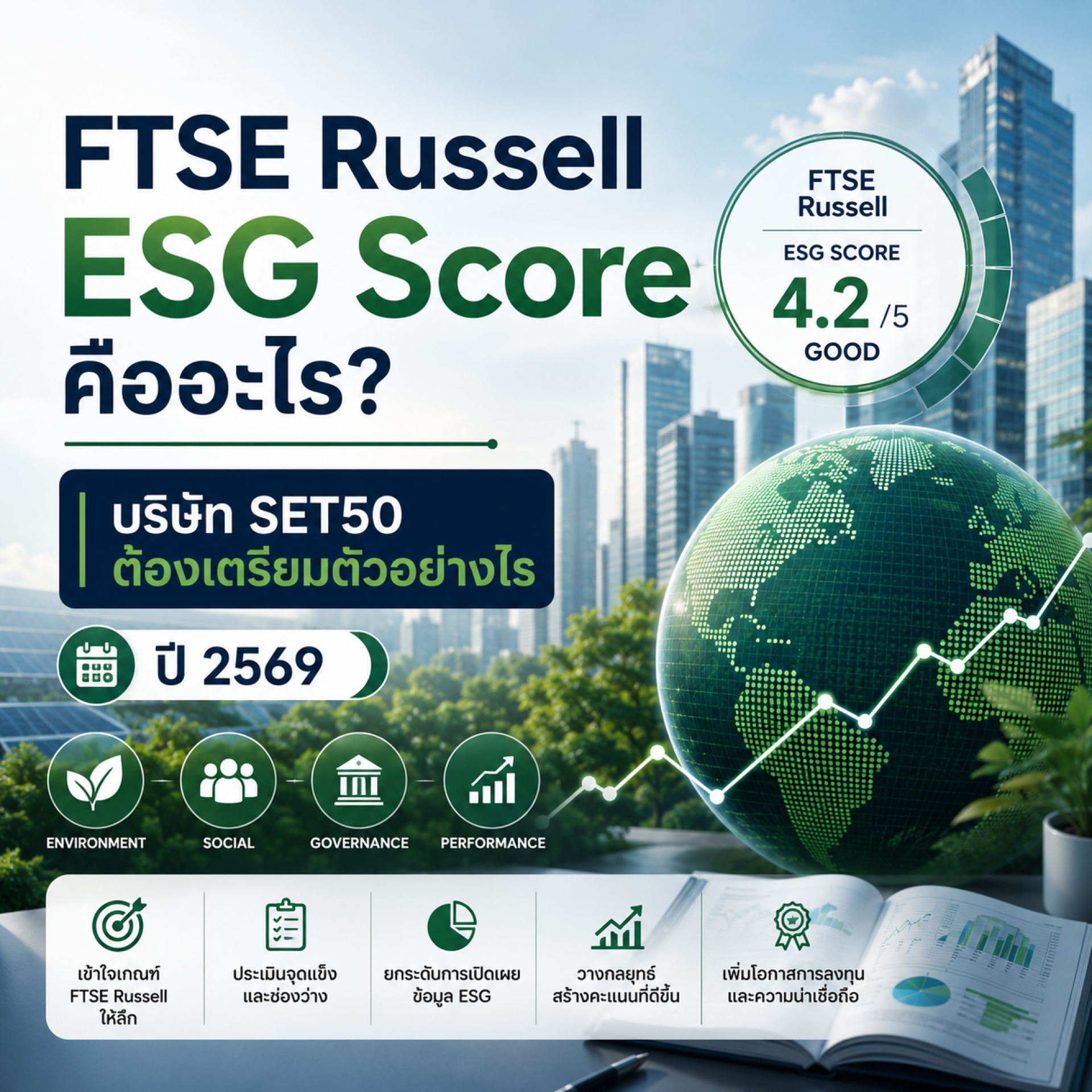
2026 represents a fundamental shift in how Thai listed companies are assessed on sustainability. The Stock Exchange of Thailand has transitioned from the SET ESG Ratings framework — used for over a decade — to FTSE Russell ESG Scores, a globally recognised standard used by institutional investors in 47 countries. This article explains everything SET50 executives need to understand.
1. What Is the FTSE Russell ESG Score?
FTSE Russell — formally the Financial Times Stock Exchange Russell — is one of the world's leading index and data providers, operating within the London Stock Exchange Group (LSEG). It provides ESG ratings for more than 7,200 companies across 47 markets globally.
The FTSE Russell ESG Score is expressed on a scale of 0 to 5, structured across three pillars:
▪ Environmental (E): Carbon emissions management, water use, biodiversity, pollution and resource use, and supply chain environmental standards.
▪ Social (S): Labour standards, health and safety performance, human rights, community relations, and supply chain social management.
▪ Governance (G): Board structure and independence, audit quality, anti-corruption programmes, risk management, and executive remuneration.
2. Why Did SET Move from SET ESG Ratings to FTSE Russell?
The transition reflects a strategic response to three converging pressures:
▪ International investor expectations: Global ESG funds use FTSE Russell as a primary benchmark. Companies assessed under a proprietary domestic framework are harder to compare — and therefore less attractive to foreign capital.
▪ Alignment with ISSB and global standards: FTSE Russell's methodology maps closely onto IFRS S1/S2, TCFD, and GRI — creating a coherent data ecosystem for Thai companies pursuing international credibility.
▪ Independence and transparency: Third-party scoring by FTSE Russell carries greater credibility than a self-assessment model, increasing trust among investors, lenders, and other stakeholders.
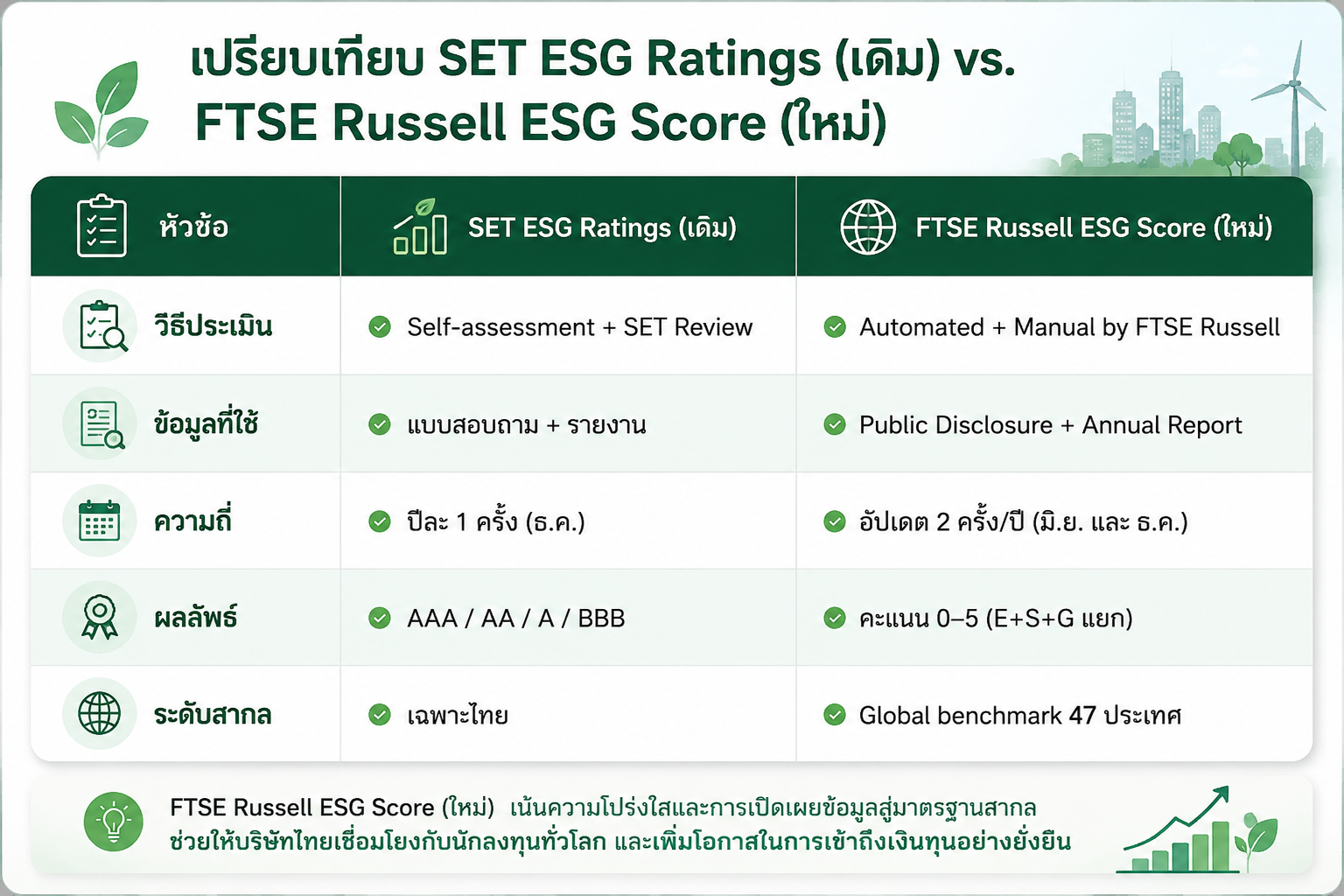
3. FTSE Russell vs. Old SET ESG Ratings: Key Differences
4. SET50 Companies Are Assessed Automatically — No Opt-In Required
This is one of the most important points that many executives are still unaware of: FTSE Russell assesses every SET50 company automatically, without requiring any formal registration or submission. The assessment is driven entirely by publicly available information, including:
▪ The 56-1 One Report (Annual Report)
▪ The Sustainability Report or SD Report
▪ The company's Investor Relations website
▪ Announcements filed with the Stock Exchange
The Golden Rule of FTSE Russell: If it is not disclosed in your public reports, it does not exist. Strong performance that goes undisclosed scores zero.
5. The Most Common Gaps Found in Thai Companies
Based on ESG PRO's review of Thai listed company reports, the following gaps appear most frequently and have the largest impact on FTSE Russell scores:
1. Incomplete Scope 3 disclosure: FTSE Russell awards significant weight to companies that report value chain emissions comprehensively. Most Thai companies report only Scope 1 and 2.
2. Inadequate board diversity reporting: Gender diversity ratios, independence percentages, and tenure data must be disclosed explicitly — not merely implied.
3. Missing biodiversity policy: A formal policy on biodiversity and land use is required for full Environmental pillar scoring. Many Thai companies have not published one.
4. Insufficient Human Rights Due Diligence (HRDD): FTSE Russell expects documented HRDD processes covering the supply chain, not just internal operations.
5. Incomplete anti-corruption programme disclosure: Policy alone is insufficient. Training reach, reporting mechanisms, and monitoring outcomes must all be disclosed.
6. A Practical Six-Month Action Plan for SET50 Companies
For companies aiming to improve their FTSE Russell score ahead of the next assessment cycle:
▪ Month 1–2: Conduct a FTSE Russell Gap Assessment with ESG PRO — identify which criteria are missing or underscored.
▪ Month 2–3: Fill disclosure gaps strategically — focus only on the highest-impact items that FTSE Russell weights most heavily in your sector.
▪ Month 3–4: Update your Sustainability Report to ensure all required disclosures are explicitly stated, not merely implied.
▪ Month 4–5: Review your Annual Report, IR website, and stock exchange announcements for consistency and completeness.
▪ Month 5–6: Run a Score Simulation with ESG PRO to test projected scores before the official assessment window.
Frequently Asked Questions
Q: How does FTSE Russell obtain data if we do not submit anything?
A: FTSE Russell uses automated data extraction tools to scan publicly disclosed documents — annual reports, sustainability reports, and company websites. Supplemental data portals may also be opened for specific companies during the assessment cycle. ESG PRO monitors these windows and supports clients in submitting additional data where permitted.
Q: What are the consequences of a low FTSE Russell score?
A: Companies with low scores risk exclusion from ESG-linked indices, which reduces access to a growing pool of capital. International institutional investors — including sovereign wealth funds and ESG-mandated pension funds — use FTSE Russell scores as a primary screening filter.
Q: Can we dispute an incorrect score?
A: FTSE Russell operates a Data Review process through which companies can submit evidence to correct inaccurate scores. ESG PRO assists clients in preparing and submitting supplemental data challenges when scores do not reflect actual performance.
Q: Does ESG PRO provide full FTSE Russell preparation support?
A: Yes. Our service covers the complete cycle: Gap Assessment, Score Simulation, Report Enhancement, Data Review contestation, and Ongoing Monitoring across every subsequent assessment round.
Q: How does FTSE Russell scoring differ by sector?
A: FTSE Russell applies sector-specific materiality weightings. For example, Carbon Emissions carries far greater weight for energy and industrial companies than for financial services firms. ESG PRO tailors preparation strategies to your specific sector's weighting profile.