SEC Thailand Mandatory ESG Disclosure Timeline 2026–2030: A Clear Roadmap for Listed Companies
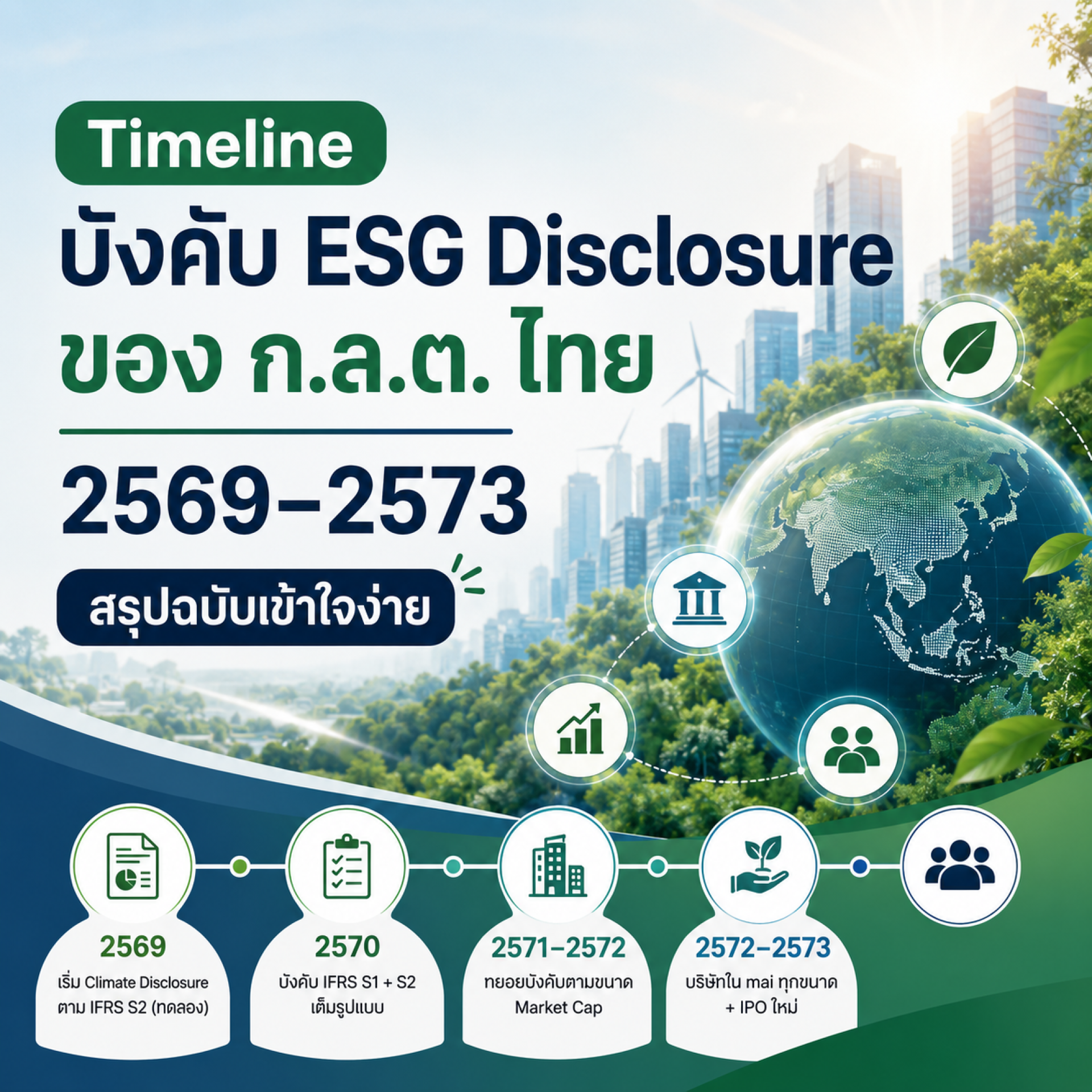
2026 marks a watershed moment for Thailand's capital markets. The Securities and Exchange Commission (SEC) is phasing in mandatory ESG disclosure requirements aligned with ISSB Standards — affecting every company listed on the SET and mai exchanges. This guide presents a clear, actionable roadmap so that executives and sustainability teams can plan ahead with confidence.
1. Thailand's ESG Regulatory Ecosystem
Three key regulatory bodies shape ESG disclosure requirements for Thai listed companies:
▪ The Securities and Exchange Commission (SEC Thailand): Mandates disclosure requirements for listed companies through the 56-1 One Report annual filing, and is driving the alignment with ISSB Standards.
▪ The Stock Exchange of Thailand (SET): Administers ESG-related indices and, as of 2026, has transitioned from SET ESG Ratings to FTSE Russell ESG Scores as the primary ESG assessment framework.
▪ The Bank of Thailand (BOT): Sets ESG and climate risk disclosure requirements specifically for financial institutions, aligned with global frameworks including TCFD.
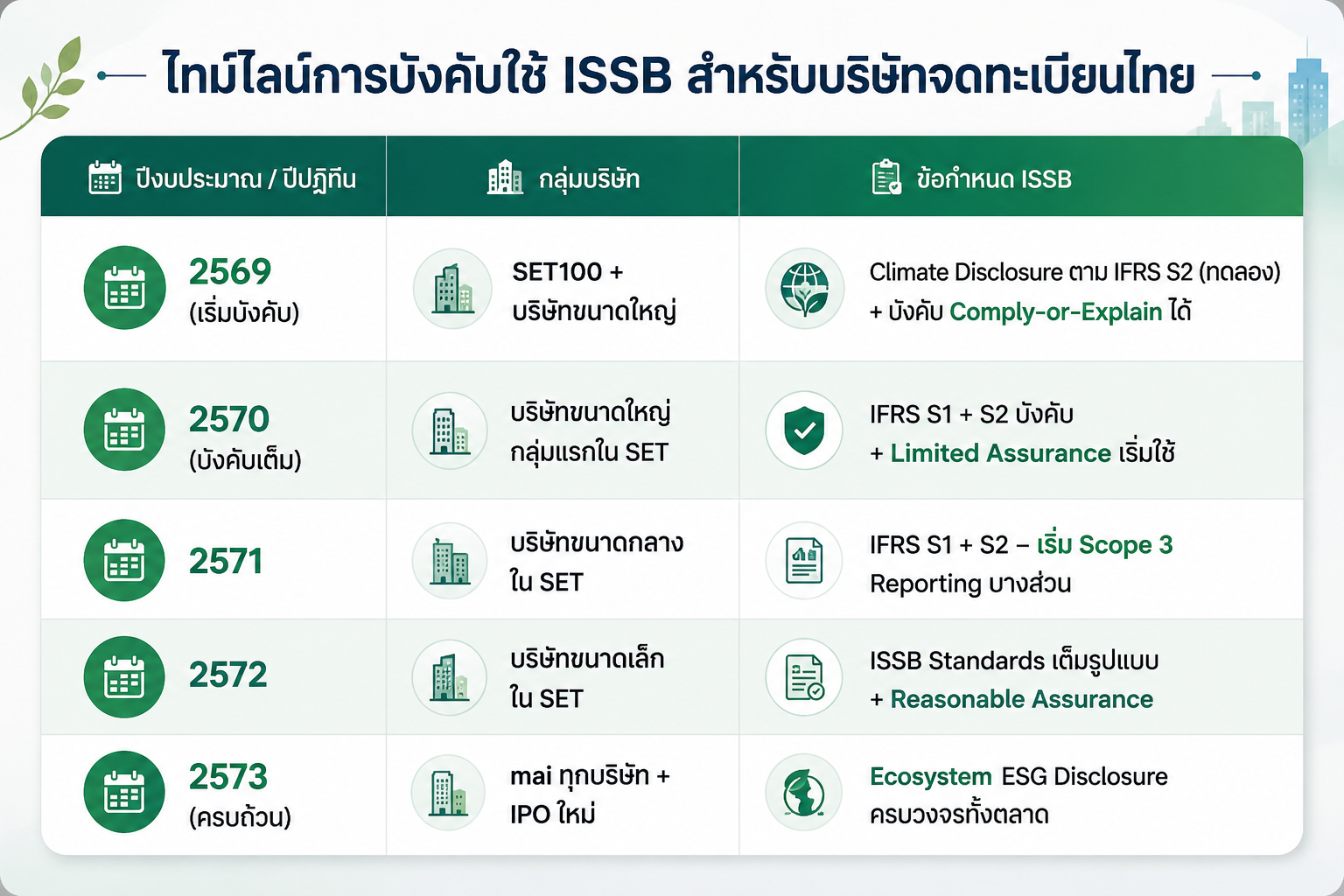
2. The Master Timeline: 2026–2030
The following table summarises the key milestones that Thai listed companies must be aware of and plan for:
3. What Each Phase Requires in Practice
Phase 1 (Now through 2026): Build the Foundation
▪ Conduct an ISSB Gap Analysis to understand the distance between current reporting and IFRS S1/S2 requirements.
▪ Establish a Sustainability Governance structure — at minimum, a Board-level Sustainability Committee with clear mandates.
▪ Implement a GHG data collection system, prioritising Scope 1 and Scope 2 as the starting point.
Phase 2 (2027–2028): Implement and Report
▪ Complete a Climate Scenario Analysis covering 1.5°C, 2°C, and higher warming scenarios as required by IFRS S2.
▪ Expand data collection to Scope 3 — beginning with the most material categories for your sector.
▪ Produce your first ISSB-aligned report and prepare it for Limited Assurance by an independent verifier.
Phase 3 (2029–2030): Achieve Maturity
▪ Upgrade to Reasonable Assurance for all disclosed sustainability data.
▪ Integrate ESG metrics into financial planning, capital allocation, and executive remuneration frameworks.
▪ Publish fully comparative ISSB reports with multi-year trend data.
4. Why Acting Now — Even Before the Mandate — Is Critical
There are compelling strategic reasons not to wait for a regulatory deadline:
▪ International investors demand it now: Over 90 percent of global institutional funds screen portfolios using ESG data aligned with ISSB or TCFD. Companies without credible disclosures face a growing cost-of-capital premium.
▪ FTSE Russell is already evaluating SET50 companies: Scores are updated twice yearly in June and December. ISSB readiness directly improves FTSE Russell scores, which influence index inclusion and investor access.
▪ Building the required systems takes time: GHG data infrastructure, supplier engagement programmes, and governance frameworks cannot be established overnight. Companies that begin now will have a significant competitive advantage by 2027.
Start with a Free ISSB Gap Analysis from ESG PRO — a two-hour structured assessment that gives you a clear picture of where you stand and what investment is required. No obligation.
5. How the 56-1 One Report Will Change
The SEC is updating the 56-1 One Report format to accommodate ISSB requirements. The key additions that companies should prepare for include:
▪ A dedicated Climate Risk Disclosure section covering all four TCFD pillars.
▪ Quantitative GHG data (Scope 1, 2, and progressively Scope 3) with year-on-year comparatives.
▪ Climate Scenario Analysis narratives explaining impacts on strategy and financial projections.
▪ A statement of the Assurance engagement, including the provider's name and assurance level achieved.
Frequently Asked Questions
Q: What happens if a company does not comply?
A: During the pilot phase, a Comply-or-Explain mechanism applies — companies must publicly state why they are not complying and what steps they are taking. Once the full mandate is in force, the SEC has authority to issue formal orders, financial penalties, and public censure.
Q: Does the timeline apply to foreign companies listed in Thailand?
A: Yes. All companies listed on SET or mai, regardless of country of incorporation, are subject to SEC Thailand's disclosure requirements.
Q: Will the 56-1 One Report be the only required disclosure, or are separate sustainability reports also needed?
A: The 56-1 One Report is the primary mandatory filing. However, many SET-listed companies also publish standalone Sustainability Reports (SD Reports) to meet the more detailed expectations of international frameworks such as GRI and FTSE Russell. ESG PRO helps clients prepare both.
Q: How does SEC Thailand's timeline compare to other Asian markets?
A: Thailand is broadly aligned with Singapore, which mandated climate disclosure for large listed companies from 2025, and ahead of several other ASEAN peers. The phased approach mirrors what the IFRS Foundation itself recommends for emerging markets.
Q: Can ESG PRO help with both the regulatory and investor-facing requirements?
A: Yes. ESG PRO provides a fully integrated service covering 56-1 One Report preparation, FTSE Russell score improvement, DJSI/CDP submissions, and Assurance preparation — all coordinated by a single dedicated team.