FTSE Russell ESG Data Model: What They Collect From Your Public Disclosure | ESG PRO
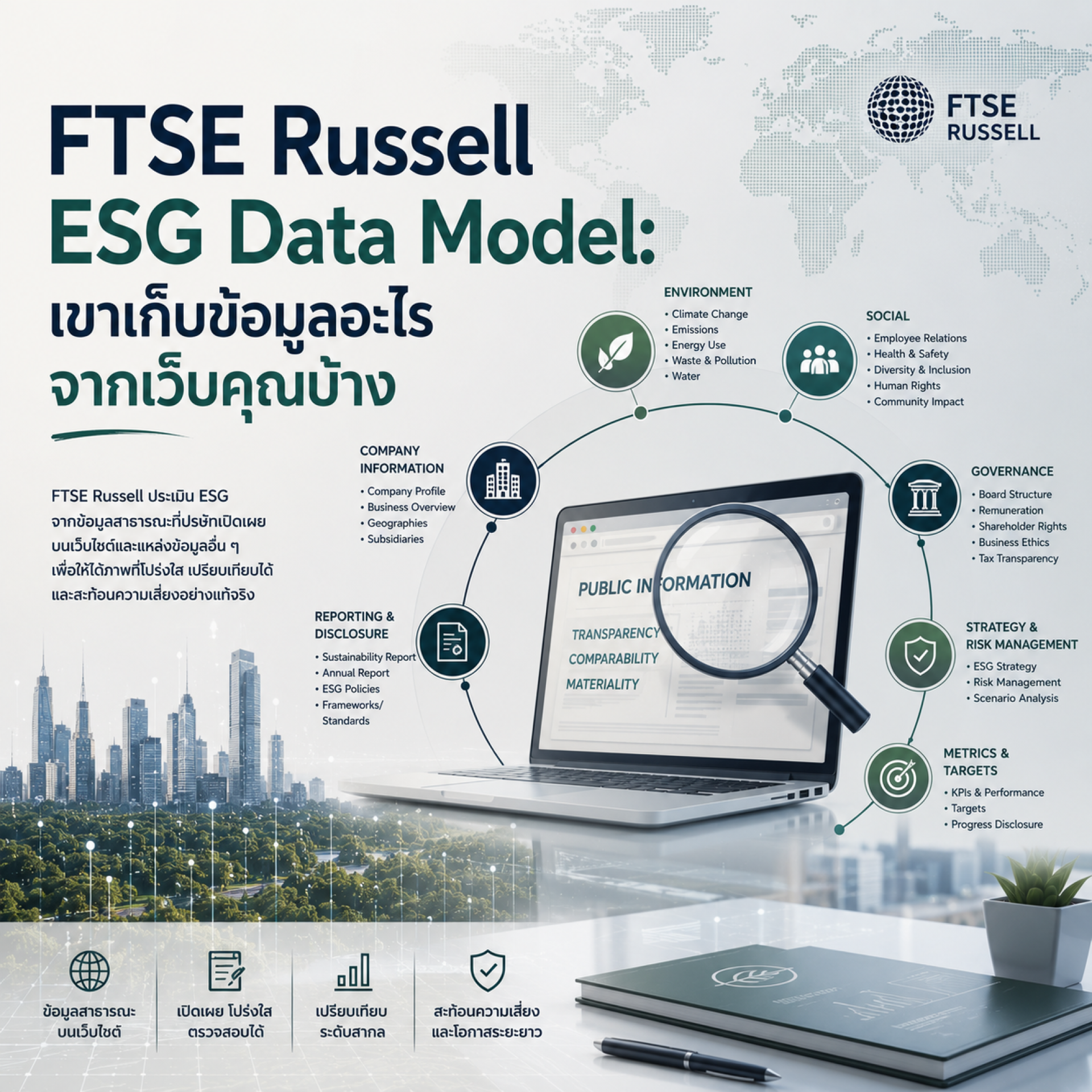
One of the most common misconceptions about FTSE Russell ESG Scores is the assumption that submitting data to SET or holding internal policies is enough to earn a strong score. The reality is that the FTSE Russell ESG Data Model draws exclusively from public disclosure. If your information is not publicly available, the system treats it as non-existent.
| The iron rule of FTSE: If it's not public, it doesn't exist. Every policy, every metric, every target you want FTSE to score must live in verifiable public documents — the 56-1 One Report, annual report, sustainability report, or your corporate website. |
What the FTSE Russell ESG Data Model Is
The FTSE Russell ESG Data Model is the system FTSE Russell uses to collect, process, and score the ESG performance of companies worldwide, automatically. The system pulls information from multiple public sources and maps it against the indicators defined in the FTSE Russell ESG Ratings Ground Rules.
Data Sources FTSE Uses
- Annual Report / 56-1 One Report (most important for Thai companies)
- Standalone Sustainability Report / ESG Report
- Corporate website — especially investor relations, governance, and sustainability pages
- Regulatory filings (e.g., Form 56-1, 53-4)
- Media coverage and news monitoring
- NGO / civil society reports
- CDP responses (if publicly disclosed)
- Company-specific controversies (e.g., lawsuits, violations, accidents)
14 Indicator Themes FTSE Assesses
| Pillar | Theme | Key Indicators |
| Environment | Climate Change | Carbon reduction strategy, GHG emissions, targets, climate scenario analysis |
| Environment | Pollution & Resources | Air pollution, water use, waste management, resource efficiency |
| Environment | Water Security | Water risk, water stewardship, water withdrawal/discharge |
| Environment | Biodiversity | Land use, deforestation, biodiversity impact, ecosystem services |
| Social | Labor Standards | Labor rights, freedom of association, working conditions |
| Social | Health & Safety | Occupational health and safety management, accident rates |
| Social | Human Rights | Human rights policy, due diligence, supply chain human rights |
| Social | Community | Community impact, indigenous rights, local engagement |
| Governance | Corporate Governance | Board structure, independence, shareholder rights |
| Governance | Anti-Corruption | Anti-corruption policy, whistleblower system, training |
| Governance | Tax Transparency | Tax strategy, country-by-country reporting, tax avoidance risk |
| Cross-cutting | Supply Chain | Supplier code of conduct, supplier ESG assessment |
| Cross-cutting | Risk Management | ESG risk integration, board risk oversight |
| Cross-cutting | Climate Strategy | Net zero commitment, science-based targets, transition plan |
Why Public Disclosure Matters So Much
Many companies have strong policies, clear targets, and solid performance — but do not disclose them publicly in a systematic way. The result is FTSE scores lower than they should be.
Common examples we see:
- Human Rights Policy exists, but is not published on the website → FTSE scores 0
- Climate scenario analysis was completed, but not disclosed in the 56-1 → FTSE treats it as non-existent
- Anti-corruption training exists, but % of trained employees is not reported → FTSE scores low
- Net zero target is set, but base year, scope, and interim targets are missing → FTSE does not count it
5 Steps to Prepare Data for FTSE
1. Audit Current Public Disclosure
Collect all your company's public documents (56-1, annual report, sustainability report, website) and compare them against the 14 indicator themes to identify gaps.
2. Fill Disclosure Gaps
Write or upgrade missing content — especially Governance documents, Climate Strategy, Human Rights, and Supply Chain, which are the most common gaps for Thai companies.
3. Make Data Easy to Discover
FTSE uses automated systems to extract data, so format content for discoverability: clear headings, readable tables, and keywords matching the indicators.
4. Manage Controversies
FTSE tracks controversies (lawsuits, accidents, violations). Companies should have monitoring systems and prepare proactive disclosure/explanation.
5. Run a Mock Data Review
Before the official cycle, have an external team review as FTSE does — to see how your disclosed information will be interpreted and scored.
| ESG PRO recommendation: In our experience, most Thai companies 'already have the data' but 'have not disclosed it in the form FTSE looks for.' Adjusting only the disclosure format without changing operations can lift FTSE scores by 0.5–1.0 points. |
Tools ESG PRO Uses to Help You
- Disclosure Gap Audit — compare public documents against 14 indicator themes
- Disclosure Enhancement — write/upgrade content to match criteria
- Mock FTSE Scoring — simulate the score before the real cycle
- Continuous Monitoring Dashboard — track disclosure and controversies year-round
Want to Check If Your Company Discloses Completely?
| Free offer: Disclosure Gap Quick Check (60 minutes) review your public documents against the FTSE Russell ESG Data Model by the ESG PRO team. Call +66 92-834-0989 or email Contact@esgprothai.com |
Sources
- FTSE Russell ESG Ratings Ground Rules — ftserussell.com
- FTSE Russell ESG Data Model whitepaper — lseg.com
- SET Sustainability Hub — setsustainability.com